
This article explores what colloidal silver is, how it’s made, its ancient history, and how it is commonly used and marketed today, all from an educational, non-medical perspective.
In This Article
Medical Disclaimer: This article is for informational purposes only and should not be considered medical advice. Always consult a licensed healthcare provider before trying new health practices or products.
Affiliate Disclosure: This article may contain affiliate links. As an Amazon Associate, I may earn earn from qualifying purchases at no additional cost to you.
Colloidal Silver Explained: From Ancient History to Modern Particle Science
Colloidal silver is a substance with a long, complex history—one that spans ancient civilizations, early preservation practices, and modern wellness conversations. Today, colloidal silver appears in liquids, creams, gels, and sprays, sold by corporations in health stores and online marketplaces.
What Is Colloidal Silver?
Colloidal silver is a liquid containing nano-sized silver particles suspended in purified water. These particles are extremely small and remain evenly distributed throughout the solution rather than settling.
Silver has long been valued for its physical properties, particularly before modern refrigeration, antibiotics, and preservatives existed. Today, colloidal silver is most often discussed in historical, cosmetic, and general wellness contexts.
Silver is not recognized as a medical treatment and should not replace professional medical care.
Colloidal silver is often categorized based on how it is produced and the characteristics of the particles within it. While the basic concept remains the same—silver suspended in liquid—the variation in production methods, particle dispersion, and purity levels can lead to noticeable differences in how products look, feel, and are marketed to consumers.
Factors That Influence Product Quality
Not all colloidal silver products are created equally. Several factors can influence overall quality and consistency, including:
• Purity of the silver source
• Type of water used (distilled vs. tap)
• Electrical process control
• Storage conditions (light exposure, container type)
Higher-quality products typically focus on controlled production environments and consistent particle distribution, which helps maintain a more uniform final solution.
How Colloidal Silver Is Made
Colloidal silver is typically produced using:
• Pure elemental silver
• Distilled or purified water
• A controlled electrical process
This process releases nano-sized silver particles into the water, forming a colloidal suspension. The quality of the final product depends on factors such as particle size, purity, and production standards.
Modern manufacturing methods aim for consistency, while historical versions were far more variable.
Common Nanoparticle Silver Size Ranges
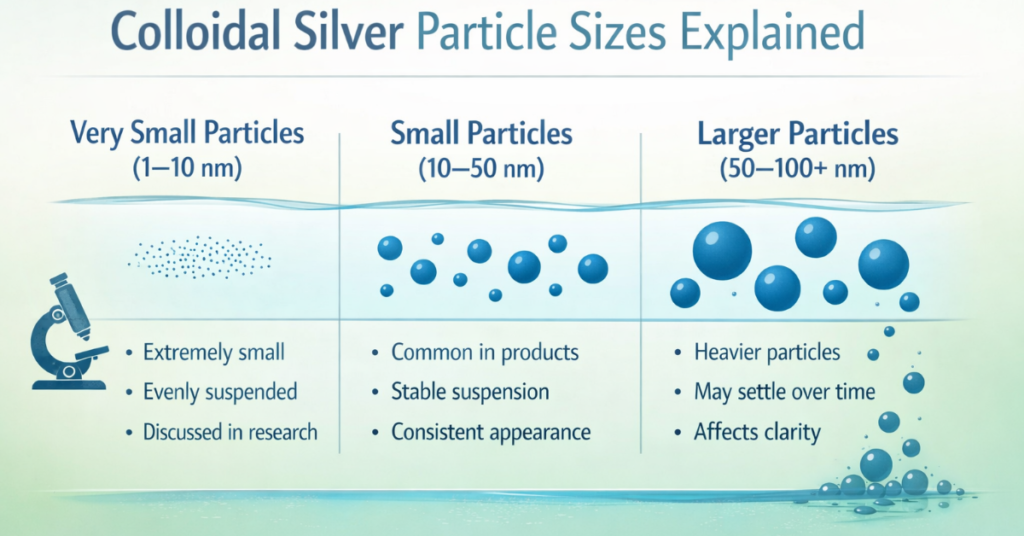
Manufacturers and researchers often reference these general ranges when discussing colloidal silver:
Very Small Nanoparticles (1–10 nm)
• Extremely small and lightweight
• Tend to remain evenly suspended
• Often discussed in scientific or laboratory contexts
• Usually invisible to the naked eye
These particles are frequently mentioned in technical discussions about stability and dispersion, not medical outcomes.
Small Nanoparticles (10–50 nm)
• Commonly referenced in commercial colloidal silver products
• Balance between suspension stability and visibility
• Often marketed as “fine particle” solutions
This range is popular because particles remain suspended while still being measurable and consistent during production.
Larger Nanoparticles (50–100+ nm)
• Heavier particles
• More likely to settle over time
• Can affect clarity and appearance of the liquid
Larger particles are sometimes associated with less stable suspensions, which is why modern manufacturing often focuses on consistency rather than size alone.
Why Particle Size Matters
Particle size matters primarily for physical and commercial reasons, including:
Stability
Smaller particles tend to stay evenly suspended longer, which affects:
• Shelf appearance
• Uniformity
• Consumer expectations
Consistency & Quality Control
Manufacturers track particle size to:
• Maintain batch consistency
• Meet labeling and regulatory expectations
• Ensure repeatable production standards
Appearance
Particle size influences:
• Clarity vs cloudiness
• Color tones (clear, pale yellow, grayish)
• Sediment formation over time
These visual cues often shape consumer perception, even though they are not indicators of medical effectiveness.
Particle Size vs. Concentration (Often Confused)
Particle size is not the same as concentration.
• Particle size refers to how small each particle is
• Concentration refers to how many particles exist in the solution
A product may have:
• Small particles at low concentration
• Larger particles at higher concentration
This distinction is important for understanding labels and marketing language.
While particle size is often highlighted in product descriptions, it is just one of many technical characteristics. Consumers may notice that marketing language emphasizes size ranges, but in practice, overall formulation, handling, and storage also contribute to how a product performs and how stable it remains over time.
A Look at the Ancient History of Silver
Silver’s association with cleanliness and preservation dates back thousands of years.
Ancient Civilizations
• Ancient Greeks and Romans stored liquids in silver containers
• Persian cultures used silver vessels for water storage
• Ayurvedic traditions referenced silver (Rajata) symbolically and historically
Middle Ages
• Silver utensils were associated with wealth, purity, and longevity
• The phrase “born with a silver spoon” originated during this time
These practices helped shape silver’s long-standing reputation well before modern science.
These historical uses were based on observation rather than modern scientific testing, yet they continue to influence how silver is perceived today. This blend of tradition and curiosity is one reason silver-based products remain relevant in modern wellness discussions.
Why Corporations Sell Silver-based Solutions
Some corporations sell silver-based solutions because there is ongoing consumer interest rooted in history, tradition, and personal care trends.
These products are typically sold as:
Cosmetic products, for topical wellness items, and dietary supplements (where legally permitted)
Reputable manufacturers are required to avoid medical claims and include disclaimers stating that their products are not intended to diagnose, treat, cure, or prevent disease.
Common Forms of Colloidal Silver Found in Stores
Colloidal Silver Cream & Gel
These Colloidal creams are the most widely accepted and commonly sold forms.
They are often used as part of:
• Skin care routines
• Cosmetic hygiene
• Supporting the skin’s natural barrier
• General topical wellness practices
They are typically found alongside herbal salves, zinc creams, and aloe-based products.
Colloidal Silver Spray
This Silver Spray is usually marketed for external use only and positioned within personal care or cosmetic categories.
Common uses include:
• Skin surface cleansing
• Cosmetic freshness
• Non-medical hygiene routines
Colloidal Silver Liquid
Colloidal silver liquid remains the most discussed form.
Corporations that sell colloidal silver liquid versions generally market them as:
• Wellness products
• Dietary supplements (with regulatory disclaimers)
• Or for topical or cosmetic use
Health authorities encourage consumers to carefully read labels and understand intended use.
How to Choose a Colloidal Silver Product
When browsing colloidal silver products, it’s helpful to focus on transparency and labeling rather than marketing claims. Consider looking for:
• Clearly labeled ingredients
• Intended use (topical vs. other)
• Storage instructions
• Reputable brand practices
Choosing products from trusted sources can help ensure you understand exactly what you’re purchasing and how it is meant to be used.
Best Colloidal Silver Products for Topical Use
If you’re looking to explore colloidal silver as part of your skincare or personal care routine, choosing a well-formulated topical product is key. Below are some popular options known for quality, simplicity, and ease of use.
Best Overall: Colloidal Skin Cream
A ready-to-use cream that blends colloidal silver with skin-friendly ingredients, making it a convenient option for everyday use. Ideal for those who want a simple addition to their skincare routine without mixing or DIY preparation. Great for: daily skincare, simplicity, beginners
Colloidal silver creams are often included in natural skincare routines alongside ingredients like tallow—learn more in our guide on The Uses and Benefits of Beef Tallow for Skincare.
Best Natural Option: Colloidal Gel
This lightweight gel is often preferred by those who want a minimal, clean-feeling product. It absorbs quickly and works well in routines that focus on natural and simple ingredients. Great for: lightweight feel, minimal routines.
Best Multi-Use Option: Colloidal Spray
Sprays are versatile and easy to apply, making them a popular choice for quick, external use. They’re often used for general skin hygiene and on-the-go convenience. Great for: convenience, travel, quick application.
Best for DIY: Pure Colloidal Silver Liquid
For those who prefer a hands-on approach, a pure liquid allows you to create your own creams, sprays, or blends at home. This option offers flexibility but requires proper understanding of usage and storage. Great for: DIY skincare, customization.
If you enjoy building a natural wellness routine, you may also like our guide on 10 Natural Remedies Every Home Should Have for more simple, time-tested solutions.
What is Colloidal Silver Used For
Colloidal silver is often discussed within historical, cosmetic, and general wellness contexts, particularly in relation to traditional practices and personal care routines. Many individuals include it as part of a broader approach within alternative medicine for common health conditions to promote holistic wellness and integrative healing.
From a historical and consumer perspective, nano-sized silver particles are often associated with supporting:
• Cleanliness
• Preservation
• Skin hygiene
• Traditional wellness practices
• Ancestral knowledge
These perspectives are cultural and historical, not clinical or medical claims.
Why Interest in silver particle solution Continues
silver particle solution continues to spark curiosity due to:
• Its deep historical roots
• Interest in pre-antibiotic practices
• Growth of holistic and traditional wellness education
• Demand for minimalist personal care products
Understanding this context helps separate education and history from unsupported health claims.
For many people, interest in colloidal silver is less about specific outcomes and more about simplicity, tradition, and curiosity. As consumers move toward minimalist and ingredient-conscious lifestyles, products with long historical backgrounds often regain attention.
If you’re interested in exploring a topical option, a well-formulated colloidal silver cream can be an easy way to incorporate it into your routine. Look for products designed for external use with clear labeling and simple ingredients—this Colloidal Silver Skin Cream is a popular choice for those seeking a gentle, ready-to-use option.
This growing interest in traditional remedies also overlaps with other natural approaches, such as grounding and mineral-based wellness practices—explore our guide on grounding for a deeper look.
Safety, Regulation, and Awareness
Health authorities, including the FDA, have stated that:
• silver particle solution is not approved as a medical treatment
• Internal use may carry risks
• Product claims are closely regulated
For this reason:
• Reputable brands use conservative language
• Claims focus on cosmetic or general wellness contexts
• Consumers are encouraged to consult qualified professionals
Key Takeaways
• Colloidal silver has a long history rooted in traditional practices
• Modern products vary based on production and particle size
• Most products today are marketed for cosmetic or general wellness use
• Understanding labeling helps consumers make informed choices
Final Thoughts
silver particle solution sits at the intersection of ancient tradition, modern consumer interest, and regulatory oversight.
While not a medically approved treatment, its long history and continued presence in topical and wellness products make it a topic worth understanding from an educational standpoint.
Informed awareness, critical thinking, and professional guidance remain essential when exploring any wellness-related product.
Common Misconceptions About Colloidal Silver
There are several common misconceptions surrounding colloidal silver, especially online. One of the most frequent is the idea that all silver solutions are the same. In reality, differences in production methods, particle size, and formulation can result in very different products.
Another misconception is that historical use automatically translates to modern effectiveness. While history provides context, today’s products are best understood through labeling, intended use, and current regulations.
For those exploring broader wellness topics, you can also read about how stress and lifestyle impact the body in our post on adrenal health and balance.
Colloidal silver is often explored alongside other natural wellness practices. From herbal remedies to gut health and stress support, combining simple approaches can help create a more balanced daily routine.
You may also enjoy:
- Natural Ways to Boost Gut Health
- Adaptogenic Mushrooms for Stress Support
- DIY Natural Medicine Cabinet
- Alternative Medicine for Common Health Conditions
- 5 DIY Natural Makeup Recipes for a Holistic Beauty Routine
FAQ’s
What is colloidal silver?
Colloidal silver is a liquid that contains microscopic silver particles suspended in purified water. These particles are extremely small and remain evenly distributed throughout the liquid rather than settling at the bottom. Colloidal silver is most often discussed in historical, cosmetic, and general wellness education contexts.
What is colloidal silver used for today?
Today, colloidal silver products are commonly sold for topical, cosmetic, or general wellness purposes. Uses typically focus on skin care routines, personal hygiene, and educational interest, rather than medical treatment.
Is colloidal silver safe?
Safety depends on how a product is used and how it is labeled. Health authorities caution against internal use and emphasize the importance of following product directions and consulting qualified professionals regarding health concerns.
What does “particle size” mean in colloidal silver?
Particle size refers to how small the individual silver particles are within a colloidal silver solution. These particles are measured in nanometers (nm) and are far too small to be seen without specialized equipment. Particle size affects physical characteristics, such as suspension and appearance, rather than medical effectiveness.
Why do silver solution products mention nanoparticle size?
Manufacturers often mention nanoparticle size to describe production quality, consistency, and stability. Smaller particles tend to remain evenly suspended in liquid, which can influence clarity and shelf appearance. These descriptions are technical and informational, not medical claims.
Is particle size the same as concentration?
No. Particle size and concentration are different:
Particle size describes how small each particle is
Concentration describes how many particles are present
A product can have very small particles at low concentration or larger particles at higher concentration.
Why was silver used historically?
Historically, silver was used for storage, preservation, and cleanliness. Ancient civilizations observed that silver containers helped maintain freshness, long before modern scientific explanations existed.
Should nanoparticle silver replace modern medical care?
No. Colloidal silver should never replace professional medical advice, diagnosis, or treatment. It is best understood as a topic of historical and educational interest or as a cosmetic wellness product, depending on form.
Why do companies sell silver-based creams and sprays?
Companies sell colloidal silver creams and sprays due to consumer interest in traditional wellness practices and topical personal care products. These items are usually marketed for external use, cosmetic hygiene, or skin-care routines, not medical purposes.
Resource: Antimicrobial Colloidal Silver in Medicinal and Consumer Applications
Read Healing Ailments editorial standards
For additional tools and digital guides that support natural wellness practices, visit my Wellness Resources page.